
Establish Your Trust Contract Before Creating for Others


Many people are talking about "using AI." Fewer people talk about operating it — running multiple models across multiple tools, deciding what each one is trusted to touch, and knowing exactly where the team needs to step in. End to end, this is the system, and systems need governance.
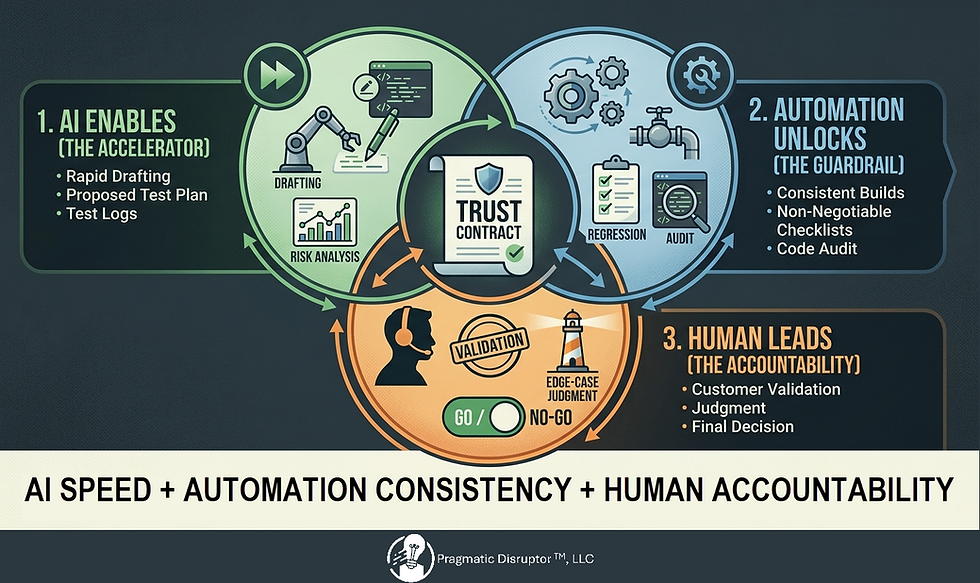
The result is The IDE Trust Contract, a free framework I published this month.
This is the story of the skillset underneath it: what it actually takes, day to day, to design and run your own AI-assisted delivery system as a founder or builder, instead of just subscribing to one.
The work that produced the framework
I don’t work inside one tool. On any given week I’m directing Claude through structured, multi-step builds; running Copilot inside active codebases; using Gemini for research and cross-checking; and working in Cursor for editor-embedded agentic development. Each tool is good at a different job. None of them is good at knowing when to stop.
That’s the actual problem the Trust Contract solves. But before I could write a framework about it, I had to be doing the work the framework describes. Here’s what that work draws on.
Agentic RAG Architecture
Every one of these tools performs better when it isn’t starting from zero. That means building the retrieval layer on purpose — structured project instructions, a defined brand and design system, versioned reference documents, uploaded assets the agent can pull from instead of guessing. When I hand Claude a new document to build, it isn’t improvising a style; it’s retrieving a system I designed and stored for exactly that purpose. That’s agentic RAG in practice: not a chatbot with a memory, but a knowledge architecture an agent is built to draw from correctly.
Multi-LLM Orchestration
Different models, different jobs. I don’t ask one tool to do everything well — I route. Think of an All-in-One Printer. They do the multiple jobs “okay,” but in my experience no multi-use tool does every job perfectly. When it comes to outputs and outcomes, mediocre results are not acceptable. So, structured builds and governance-heavy output go where I can define process and results. In-IDE, fast-iteration coding goes somewhere else. Research and cross-verification goes somewhere else again. The skill isn’t picking a favorite model. It’s knowing the failure modes of each one well enough to assign work deliberately, and we should all build a habit of checking one model’s output against another when the stakes call for it.
IDE Orchestration
This is the difference between prompting and directing. Prompting is one request, one response. Orchestration is sequencing: set up the environment, run the build, catch the failure, fix the specific thing that broke, re-render, verify visually, confirm it meets objectives, and then ship. The Trust Contract PDF went through exactly that loop which is a layout technique failed silently, got diagnosed, got replaced with a more reliable method, and got re-verified page by page before it went out the door. That loop, running deliberately instead of by accident, is the actual skill.
Git Version Control
Every serious build needs a record of what changed and why. This isn’t meant for bureaucracy, and because “the model said so” isn’t an audit trail that tracks what went right and what went wrong (or the almost that are in between). The Trust Contract’s own template requires a change log for exactly this reason: version, effective date, review cadence, what changed and when. I hold my own build process to the same standard I’m asking readers to hold theirs to. That consistency is the point. We all know that results can’t be repeated or improved upon if we don’t know how those results were created in the first place.
Rapid Prototyping
Speed without a feedback loop is just guessing faster. The discipline is shipping something, checking it against reality immediately, and fixing the specific failure rather than re-planning from scratch. That’s how a broken layout becomes a working one in the same session instead of a week of back-and-forth.
The pattern underneath all five
None of this is about tool fluency for its own sake. It’s about occupying the “Authorize” lane in your own system which is the role the Trust Contract defines as the one thing AI speed can’t replace. If you’re a founder or a builder running multiple agents across multiple environments, there’s no one above you assigning that role. You either build the discipline to hold it yourself, or your system runs faster than your judgment can keep up with.
That’s the gap the Trust Contract names. This article is the proof that the gap is closeable. I’m not saying you need more tools. You likely need to leverage the operating skills you already have to run the your systems instead of stacking shortcuts.
Read the full framework: The IDE Trust Contract

Comments