
The Transformed Product Owner: From Story Writer to AI Agent Manager, A Pragmatic Disruptor™ Guide

The headlines are loud: AI is coming for knowledge work. But as a Pragmatic Disruptor, I see past the hype. AI isn't here to replace the Agile Product Owner (PO)—it's here to transform the role from a hands-on documentarian to a strategic orchestrator. The day-to-day work is shifting from generating content to managing the AI agents that generate it.

The new core competency for the PO is no longer measured in stories written per sprint, but in the governance, curation, and validation of AI-generated assets. You are now an AI Agent Manager and Data Curator, and your biggest challenge is preventing Garbage In, Garbage Out (GIGO) at scale.
The Great Shift: From Doing to Governing
For product management roles that traditionally focused on content creation—writing user stories/features/epics, market summaries, or communications—the job is fundamentally changing. The Product Owner role is being elevated, focusing on managing the why and the what instead of the mechanics of how to document. This transformation is already accelerating key areas of the Product Management scope. The value now shifts from writing content to managing AI Agents and curating their output. You don't write the user story; you govern the Agent that drafts it, ensuring it's grounded in accurate data and aligns with the strategic vision.
Today, AI tools can draft materials quickly. The new role involves overseeing these AI agents, making sure their work aligns with business goals and is based on reliable information. Leaders in particular must create the guardrails, ensuring that the teams have the right mindset and the right resources to manage the process from end-to-end.
This means product owners become AI Agent Managers and Data Curators. Their job is to:
Traditional PO Focus | Transformed PO Focus | Pragmatic Disruptor Principle |
Writing & Refining user stories, acceptance criteria, and test cases. | Governing & Curating the inputs (data) and outputs (requirements) from custom AI agents, such as a "Product Insights Assistant". | GIGO Prevention |
Manually synthesizing customer interviews, survey data, and market trends to define the problem. | Challenging the AI-generated analysis to find holes in thinking and validate ideas. AI accelerates learning and challenges biases. | Love the Problem, Not the Solution |
Documenting process flows and requirements. | Driving clarity by using AI to check for missteps in process flows, ensuring alignment to the audience and purpose. | Data-driven decision making |
GIGO Prevention: The New Operational Excellence
For the Product Owner, GIGO means feeding an AI agent ambiguous stakeholder and customer requests or outdated system documentation, leading to the rapid creation of flawed features or user stories that aren't found until technical review or post deployment.
AI’s power comes with a critical risk: if it receives poor data, it produces poor results.
When AI is fed inaccurate, biased, or outdated information, it amplifies those errors quickly and confidently. Because of this, data accuracy is not optional. Teams must treat data quality as a top priority to ensure AI-driven insights are trustworthy. This is why Data Accuracy Isn't Secondary.
Here are the three key GIGO Guardrails the new PO must enforce:
1. Govern Access and Sources (The "In" Guardrail)
The PO must be the gatekeeper, restricting AI access to unapproved data and curating the "Golden Source" of truth for core metrics and product requirements. The quality of the story depends entirely on the quality of the data the AI is reading.
Identify a single source of truth for each type of data.
Limit AI agents’ access to approved, verified data repositories.
Regularly audit data sources for accuracy and relevance.
2. Define & Validate and Challenge (The "Gut Check" Guardrail)
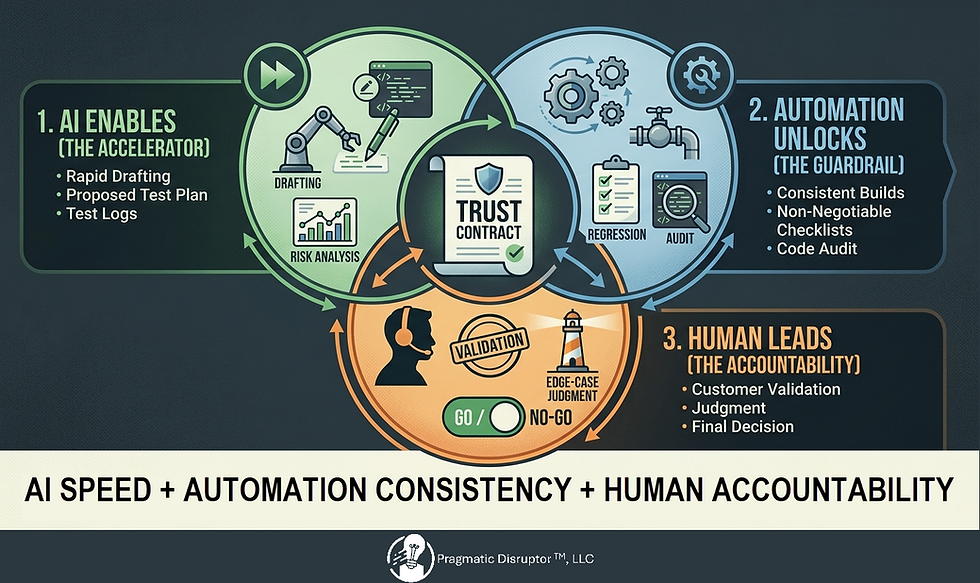
Never accept an AI-drafted story without rigorous scrutiny. The PO's job is to apply Healthy Skepticism, ensuring the output resonates with the Customer First - Team Always philosophy. Align every item to a core customer request and ensure the team is protected across the board. The PO is becoming a The Gatekeeper from ensuring waisted and lost investment and time.
In short, the PO is the strategic editor, ensuring the Human-in-the-Loop veto power is always exercised.
Specify what tasks each AI agent can perform.
Set boundaries to prevent agents from using unauthorized data.
Monitor AI outputs continuously for quality and consistency.
Educate team members about the importance of data quality.
Assign responsibility for data curation and AI oversight.
Encourage collaboration between data experts and AI managers.
3. Close the Feedback Loop (The "Out" Loop)
The work products created by the AI (user stories and requirements) must feed back into the governance process. For example, teams I have supported use AI to draft comprehensive QA scenarios. If the AI-generated test cases fail, the PO knows immediately that the input data or initial prompt was flawed, providing a clear path to improvement.
Collect feedback on AI-generated content from end users.
Adjust AI instructions and data inputs based on feedback.
Track errors and correct data sources promptly.
Elevating Strategy in the PO Role
By offloading the creation and focusing on the curation, the PO can spend more time on strategic, high-value work:
Prioritization: Instead of manually calculating priority scores, the PO manages the inputs of their standardized priority value model (e.g., MoSCoW or a custom priority model) and directs the AI to propose an optimal roadmap sequence.
Stakeholder Alignment: Leveraging AI to track and communicate roadmap delivery/health, the PO frees up time for high-touch coordination and Cross-Functional Collaboration.
Strategic Focus: Using the Urgent & Important Quadrant (Eisenhower Matrix), the PO ensures that AI-driven analysis is aligned to the highest value work, rather than just the easiest information to process.
Embracing the Transformation
The shift from content creator to AI agent manager is a chance to develop new skills and add value in different ways. It requires a mindset focused on oversight, quality control, and strategic alignment rather than manual content production.
The future Product Owner is an empowered leader who blends strategy with empathy and data. AI is simply the tool that allows them to drive farther, faster, and together, ensuring that bold change is always met with grounded execution.
This transformation is not about replacing people but about evolving roles to work effectively with AI.
Call to Action - Embracing the Transformation
If you're a Product Owner, how has your team restructured to manage AI agents? What is your favorite "GIGO Guardrail" to enforce? Share your insights—I’d love to learn from your transformation journey.
Want to learn more, contact us to setup a consultation session.

Comments