
"Garbage In, Garbage Out": The Pragmatic Disruptor's Guide to AI Governance


The Double-Edged Sword of AI
AI is no longer a futuristic concept—it's a core tool in the Pragmatic Disruptor's toolbelt, enabling faster access to information, accelerating learning, and driving process efficiency. I use it daily to validate ideas, challenge my biases, and distill complex ideas into concise, strategic messages.
However, the power of AI comes with a foundational risk: the 'Garbage In, Garbage Out' (GIGO) principle. We can easily get consumed by the solution, but as Pragmatic Disruptors, we must remain vigilant against the 'build traps'. The quality of our AI-driven insights is a direct reflection of the quality of the data we feed it. Without rigorous governance, curation, and a healthy dose of skepticism, AI becomes a liability, not a leap forward.
The Non-Negotiable Prerequisite: Data Integrity
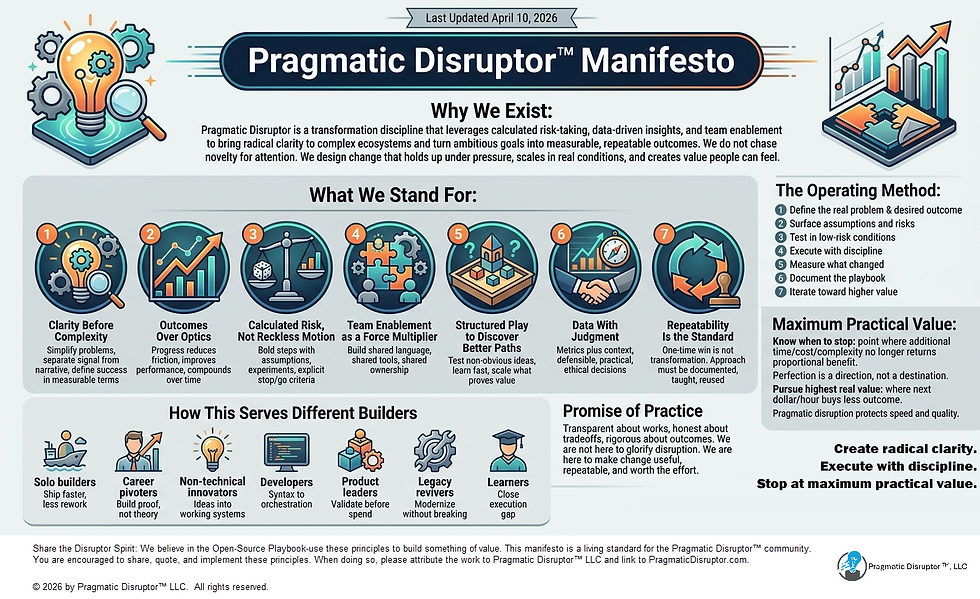
Though my philosophy, Customer First - Team Always, guides every decision, I also instill a non-negotiable tenant in my teams: Data Accuracy Isn't Secondary. For AI, this means prioritizing data integrity as the ultimate expression of trust for our customers and teams. Data-driven decision making is the core of the Pragmatic Disruptor approach. The same rigor must apply to our AI inputs.
Data Integrity is paramount because:
AI Accelerates Everything: If your AI is trained on inaccurate, biased, or outdated data, it won't just make a small mistake—it will scale and accelerate that mistake across the entire organization.
Trust is Fragile: We must be able to trust the output of our AI agents. When we leverage custom agents, like my "Product Insights Assistant," the goal is to curate information to drive strategic decisions without drowning in data or personal bias. We achieve this by diligently managing the access points and sources of our information.
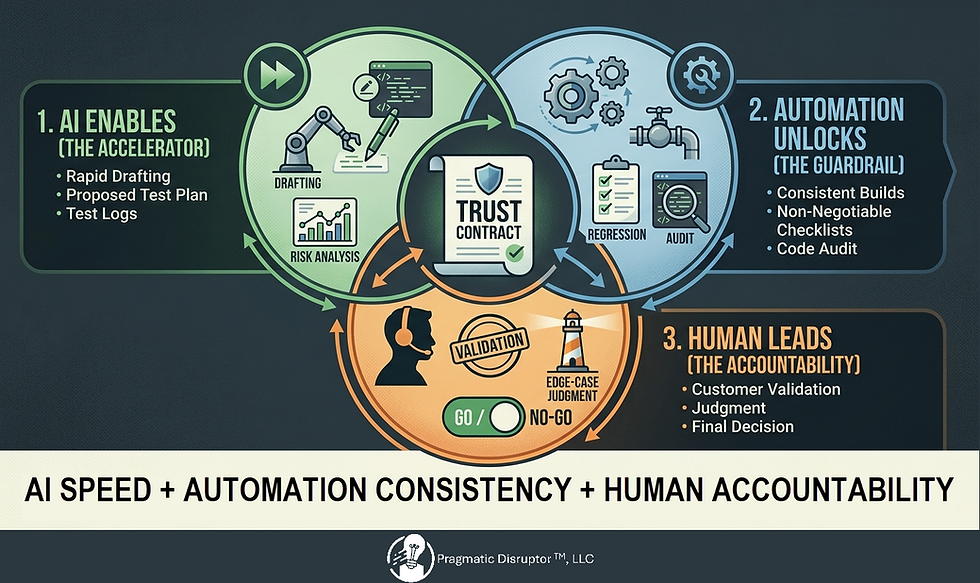
Human-in-the-Loop is Veto Power: The output must always resonate with our values and leadership style. You can use AI to draft, analyze, and critique, but before publishing, a human must ensure the genuine content wins and their own voice rings true.
The Pragmatic Disruptor’s AI Governance Checklist (GIGO Prevention)
Successful AI implementation requires grounded leadership, not just flashy technology. Here is how we enforce data integrity and governance to prevent GIGO:
1. Govern Access and Sources (The "In" Guardrail)
Restrict the Firehose: Be deliberate about what data sources your AI models and agents can access. Open access is not innovation; it's negligence. We must diligently manage the access points and sources of our information.
Curate the Golden Source: Identify and formally approve the "single source of truth" for core business data (e.g., customer metrics, product requirements). AI should prioritize these curated, trusted sources.
Metadata is Mandatory: Require clear metadata on all data inputs, including creation date, source of origin, and an integrity score.
2. Validate and Challenge (The "Gut Check" Guardrail)
Healthy Skepticism: The integration of AI requires governance, curation, and a healthy dose of skepticism. Never take an AI output as gospel.
Validation of Ideas: I use AI daily to not only accelerate learning but also to validate ideas and challenge my own biases. Encourage your teams to use it to find holes in their thinking and clarify missteps in process flows.
Focus on the Right Things: Ensure your AI-driven analysis is aligned to your audience and purpose. Leveraging frameworks like the Urgent & Important Quadrant (Eisenhower Matrix) helps to navigate the onslaught of issues and concerns and ensures focus is aligned.
3. Close the Feedback Loop (The "Out" Loop)
Measurable Impact: Success isn't just about a product launch; it's about delivering meaningful experiences. We measure success by the impact we have on our users and the outcomes we drive for the business. If the AI is not driving measurable impact, the process or data is flawed.
User Stories & QA Scenarios: Teams I lead use AI tools (like Copilot) to draft requirements and create comprehensive QA scenarios. This is a natural feedback loop—if the AI-generated test cases fail, the input data or initial prompt was likely flawed.
Retrospectives on AI Use: Implement regular retrospectives to reflect on what worked well and what can be improved, especially focusing on where AI output led to poor or excellent results.
Leading with Purpose and Data
As a Pragmatic Disruptor, I challenge the status quo with purpose and data. AI is an incredibly powerful force multiplier, but its value is entirely dependent on our discipline in governing the inputs.
Let's commit to embracing the power of AI while refusing to compromise on data integrity. Lead with grounded execution, respect the GIGO principle, and ensure your AI strategy reflects the core truth: Customer First - Team Always.

Comments